Cybersecurity teams work in an environment that changes constantly. New vulnerabilities emerge, business priorities shift, and systems evolve faster than a yearly security plan can anticipate.
Agile offers a useful way to manage that uncertainty: work in manageable increments, gather feedback early, and adjust priorities as evidence changes.
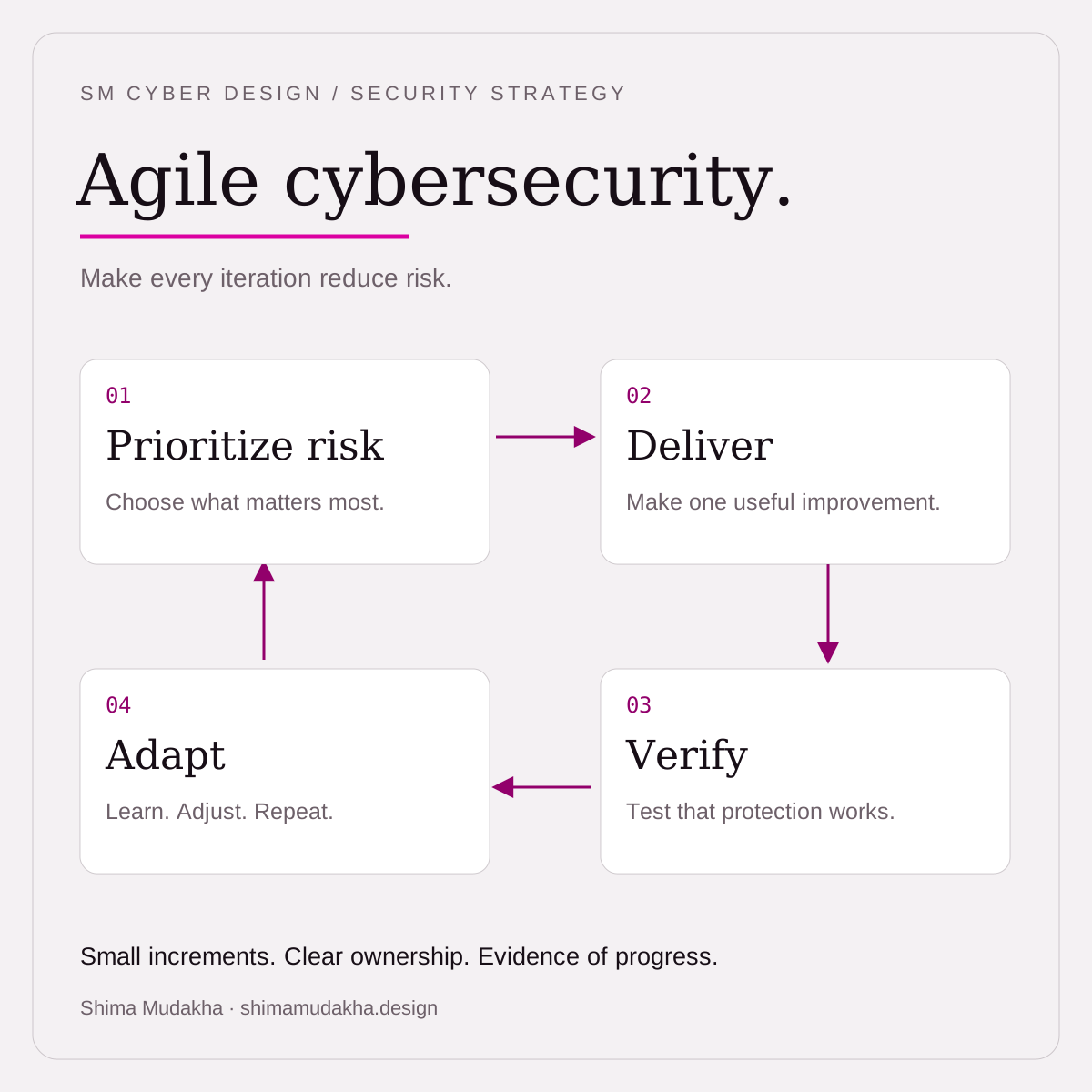
Applying agile to cybersecurity means building a continuous cycle of identifying risk, delivering improvements, testing their effectiveness, and learning from the results.
Start with security outcomes
A security backlog can quickly become a list of tools to deploy, alerts to investigate, and policies to update. Agile works better when those activities connect to clear outcomes.
For example, “implement a secrets management tool” describes an activity. “Reduce the chance that exposed credentials provide access to production” describes the outcome the team wants.
That outcome may require several changes: removing credentials from repositories, narrowing permissions, improving detection, and practicing revocation.
Starting with the outcome helps teams choose useful work and evaluate whether it reduced risk.
Build a backlog around risk
Bring security improvements into a visible backlog. Include findings from vulnerability assessments, incidents, architecture reviews, operational monitoring, and employee feedback.
Then prioritize using context. A vulnerability’s severity score matters, but so do its exposure, evidence of exploitation, the importance of the affected system, and existing protections.
An internet-facing weakness in a critical service may deserve attention before a higher-scoring issue in an isolated test environment.
Each item should explain:
- What could go wrong.
- Which systems or users could be affected.
- What improvement is needed.
- How the team will verify the result.
For risks the organization chooses to accept, record the decision, its owner, and when it should be reviewed.
Deliver improvements in small increments
Large security initiatives often take months before anyone sees a benefit. Breaking them into smaller pieces creates earlier opportunities to reduce risk and learn.
Consider a project to strengthen privileged access. A team could begin with one critical service: identify its privileged accounts, remove unnecessary access, strengthen authentication, and verify that access changes are logged. The next iteration can extend the approach using what the team learned.
Each increment should leave something meaningfully safer. Completing a planning document may support the work, but it does not necessarily change the exposure.
Bring security into everyday delivery
Security becomes easier to sustain when it is part of the way teams plan and build.
During planning, identify changes that introduce sensitive data, new permissions, external integrations, or untrusted input. Use a short threat-modeling discussion to examine what could go wrong and select appropriate controls.
Translate those decisions into acceptance criteria. For a file-upload feature, for example, the criteria might specify who can retrieve uploaded files, where processing occurs, and what access the processing service receives.
A team’s definition of done can include relevant security checks, reviewed findings, and agreed handling of remaining risks. The requirements should reflect the change’s actual exposure.
Use short feedback loops
A security control needs evidence that it works.
Automated checks can identify exposed secrets, vulnerable dependencies, and certain coding weaknesses while changes are still easy to address. Manual reviews and targeted testing can examine design decisions that automated tools may miss.
Feedback also needs a destination. Findings should reach someone who can act, with enough context to make a decision. A warning that remains unread in a dashboard contributes little.
Keep checking after deployment. Production behavior, access logs, incident reports, and user feedback may reveal assumptions that testing did not catch.
Leave capacity for the unexpected
Cybersecurity includes planned improvement and unpredictable response work. A sprint plan must accommodate both.
Reserve capacity for urgent investigations and remediation based on the team’s experience. Make incoming work visible so its effect on planned commitments is understood.
Active exploitation or a serious incident requires immediate action. Teams should have an emergency workflow that allows them to interrupt planned work, coordinate responders, and contain the threat.
For teams receiving a continuous stream of security requests, a Kanban approach can help manage flow and limit work in progress. Other teams may benefit from sprint-based planning. Choose the approach that fits the work.
Learn from incidents without waiting for your own
Public incidents can provide useful prompts for reviewing a backlog.
PHP’s March 2021 source-code incident highlighted an overlooked HTTPS authentication path into its repository. Hugging Face’s July 2026 disclosure described an intrusion that began in dataset processing and progressed through credentials and internal infrastructure. These examples raise practical questions about alternative access paths, untrusted execution, and excessive permissions. PHP incident update, Hugging Face disclosure.
The agile response is to turn relevant lessons into bounded work: review repository write paths, test the isolation of a processing service, or reduce the permissions of a service account. Assign an owner and verify the improvement.
Measure progress through effectiveness
Task counts show activity. They provide less insight into whether the organization is becoming safer.
Useful measures might include:
- How long exposed critical vulnerabilities remain unresolved.
- How quickly the team can revoke compromised credentials.
- Whether important services meet agreed security requirements.
- Whether recurring findings decrease after corrective work.
- How reliably response exercises detect and contain a scenario.
Interpret these measures in context. Faster ticket closure means little if fixes are incomplete. More alerts may indicate better visibility or excessive noise.
Use measurements to guide decisions and expose obstacles.
Make retrospectives produce change
At the end of an iteration or significant incident, examine how the work happened.
Where did ownership become unclear? Which findings arrived too late? What caused avoidable rework? Did a control create friction without delivering enough protection?
Choose a small number of improvements, give them owners, and check their effect in a later review.
This is where agile cybersecurity becomes a sustained practice. The team improves its controls and its ability to deliver those controls.
Start with one cycle
A practical first step is to choose one important security outcome and work on it over a short period.
Identify the risk, select a manageable improvement, define what success looks like, and test the result. Review what you learned before choosing the next increment.
Over time, that rhythm makes security more responsive and accountable. Teams can explain what they are protecting, why the current work matters, and what evidence shows it is helping.